
Hitler’s Black Book
As the German war machine marched across Europe, Hitler's Black Book provides a chilling insight into his plans for post-war Britain

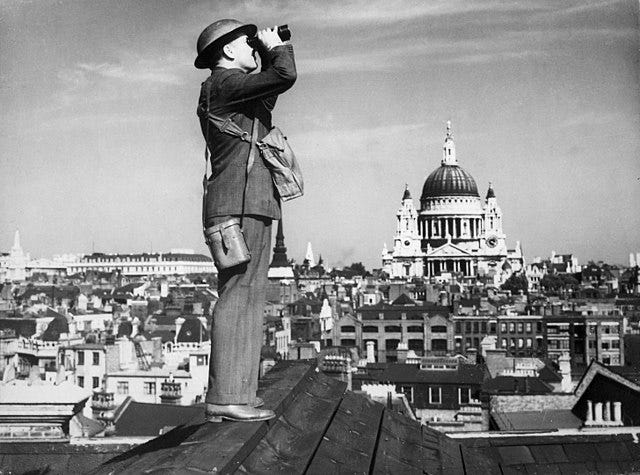

By the summer of 1940, Germany’s conquest of Europe had proceeded so triumphantly that even Hitler couldn’t have anticipated the dominating position that he now found himself in. After a quickfire conquest of Poland in September-October 1939 (alongside the Soviet Union) and a string of successful invasions of European nations throughout 1940 (Denmark, Norway, Belgium, the Netherlands and Luxembourg), the dramatic fall of France in just six weeks in May-June 1940 had left Hitler in control of a giant pan-European empire.
From east-central Europe to the Atlantic coast, the Germans had crushed all in their path, but across the Channel, one final enemy remained. In June 1940, Britain now stood alone against Germany – and became the next target of Hitler’s war machine. If defeated, Britain would become the crowning jewel in Hitler’s new European empire, with Operation Sea Lion, the planned German invasion of Britain, offering Germany complete dominance of Europe.
Winning on the battlefield was one thing, but the Germans were aware that pacifying, controlling and administering their newly gained territory – both annexed and occupied – was an entirely different matter. This required a massive and multipronged effort to purge the occupied territories of their elites: political, cultural and economic. With a range of potential enemies, from the church to underground political movements, the role of stamping out resistance would fall to the German intelligence apparatus - and this required a plan.
The Black Book
Prior to 1940, the Germans were already aware that to truly conquer a nation, they needed to first destroy its elites. Prior to the invasion of Poland in September 1939, the Sonderfahndungsbuch Polen was produced by German intelligence, providing a list of Polish targets for German soldiers and administrators. It would be used to target 61,000 Poles during the occupation due to the perceived threat of these individuals resisting German rule in Poland.
After the fall of France, an SS functionary and intelligence chief called Walter Schellenberg was asked to produce a similar guide for German military and administrative personnel – but this time for Britain. The book would focus on the key political, social and economic institutions of Britain, alongside the individuals who should be targeted once the Germans occupy the country. The final product he produced was the Sonderfahndungsliste G.B, which came to be known as Hitler’s Black Book for Britain.
The guide outlined institutions such as the Church of England, the Boy Scouts and the elite British public school system, alongside a detailed overview of the British police and intelligence agencies. It also contained a survey of cultural sites, museums and galleries across the country that the German occupying authorities could target for looting post-invasion, as they had already done on mainland Europe.
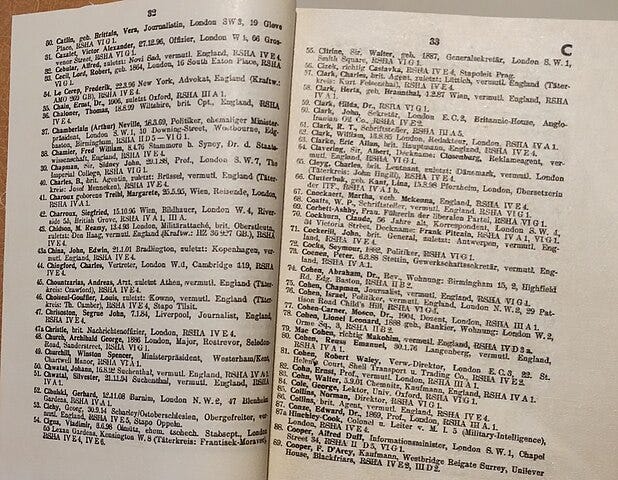
#/media/File:Black_Book_pages_32-33.jpg)
The most chilling aspect of the guide was reserved for the attached 104-page annex, which listed the names of 2820 prominent individuals in Britain to be arrested after the invasion. The German arrest list also included the professions, date of birth and known addresses of each individual, with the annex providing the occupying authorities with a definitive set of targets to stamp out any opposition in a German-dominated Britain.
Making the list
The individuals that made up the list included prominent politicians and members of the War Cabinet, influential business leaders, leaders of European governments in exile and Jewish emigrants. The most important entry was, of course, Winston Churchill, who appeared in entry number 49 of the ‘C’ section, whilst former Prime Minister Neville Chamberlain was also listed as a target.
Labour politicians such as Clement Attlee (listed twice) and Ernest Bevin were also noted, alongside other prominent Conservative politicians like Duff Cooper (a former Secretary of State for War), Leo Amery, Anthony Eden (Secretary of State for War and soon to be Foreign Secretary), Lord Vansittart (a senior diplomat), Neville Henderson (former British Ambassador to Germany) and Lord Halifax (Foreign Secretary in the Chamberlain government).
Among foreign leaders, Charles de Gaulle was included on the arrest list, as was President of the Czechoslovak Government in exile Edvard Beneš, Czechoslovak Foreign Minister Jan Masaryk, and former Polish Prime Minister (and pianist) Ignacy Jan Paderewski. Other senior officials of states conquered by the Germans, such as the former Polish Minister of Foreign Affairs August Zaleski, also made the list.
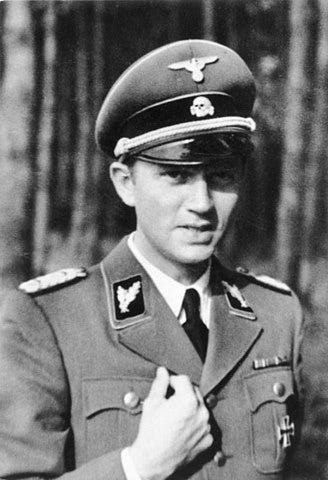
#/media/File:Bundesarchiv_Bild_101III-Alber-178-04A,_Walter_Schellenberg.jpg)
Alongside political figures, the list contained the names of activists, literary figures and the cultural elite. Suffragist Sylvia Pankhurst was included, as was left wing publisher Victor Gollancz, writer Aldous Huxley (who had already emigrated to the US before the war) and Virginia Woolf.
As expected, German emigrants featured heavily on the list, as did Jews, socialists and communists. Ernst Hanfstaengl – a businessman and former ally of Hitler - was included, as was Chaim Weizmann, a Jewish Zionist and later the first President of Israel.
A vision for the future?
The Black Book offers a chilling insight into what an occupied Britain would look like, alongside who the Germans actively saw as a source of resistance. In September 1940, SS-Brigadeführer Dr Franz Six was given the task of overseeing the arrests and leading the clampdowns, as Hitler put preparations in place for an invasion of Britain.
Thankfully, it was not to be. Due to the difficulties of invading the country and British success in the skies during the Battle of Britain, the invasion was postponed indefinitely – and Hitler eventually abandoned all hope of launching it. However, Hitler’s Black Book provides us with a glimpse into a possible Nazi-occupied Britain, alongside who German authorities perceived as a potential challenge to their tyrannical rule.
On mainland Europe, the Nazis stopped at nothing to stamp out opposition and cement their position as conquerors, but the island fortress of Britain proved to be a set too far for Hitler. The Black Book presents an alternative vision of the future, in which Hitler’s all-powerful war machine was once again successful – as it had been throughout the early years of the war.
It also lays bare the ruthlessness of the German regime, who freely targeted politicians, cultural figures and religious institutions to serve their goal of European conquest. The 2820 individuals on the list avoided their fate, but given the opportunity, British history may well have taken a very different turn.